
Making sense of losing someone you love
This February, I made the most difficult decision in my life. I let go of my Soul Cat, my best friend, the feline love of my life.
After a full life of 19+ years, and more than 17 years spent sleeping side-by-side, his time here on earth had come. But he is still with me, in memory, in connection and - hopefully - in spirit.
Every moment in that last week was filled with love and care for each other, and an immense feeling of gratitude. Without words, we had hour-long conversations. When the vet came to our home for his euthanasia, he had one last rally in him: to climb on top of her doctor’s bag, despite having no control of his hind legs. He was showing me how glorious he was until the end - a proud lion on top of his perch.

The process of letting go of what we can see and touch
After Lewis died peacefully, I washed and dried him and cleaned his teeth, so that wherever he was going, he’d arrive there clean. I was able to hold him that evening as rigor mortis set in. When I went to sleep that night, I knew his body would still be there the next morning. He was there, on his cushion, wrapped in my (his) favourite fluffy bathrobe.
Having this slow transition of him being alive, then dead but warm, and slowly cool and stiff, helped my grieving process. He wasn’t taken away from me suddenly, his body put in a freezer by someone who didn’t know or love him.
It was important for me to clean him and make sure he smelled familiar.
Besides being a proud feline with a glorious set of manes, grooming each other was one of our love languages. When he was younger, I would frequently wake up to find Lewis lying on my pillow, gently nibbling at the roots of my hair, ensuring my hair was clean according to his immaculate standards.
The next morning, we brought him to the crematorium I had carefully picked out a few months ago. As I sat in the passenger seat, with Lewis’s body cradled in my arms, a zippy white car was driving in front of us as we left town. Its license plate read LEW. I kid you not.
We spent a couple of hours at the crematorium, picking out an urn, setting his paw print in clay, and finally, wrapping him in his shroud. Made from the train of my wedding dress, this pouch of bamboo silk fitted around his body perfectly. I then put him in the cremator, said a thousand final goodbyes, and pushed the button. We watched the temperature rise, knowing the emergency button was always there to stop the process… But also knowing it wasn’t going to change anything.
The connection between Lewis and me was always going to be there, even if his physical body was not.
“It was such a strange tormenting feeling when your dæmon was pulling at the link between you; part physical pain deep in the chest, part intense sadness and love. And she knew it was the same for him. [...] The pain in Lyra’s heart grew more and more unbearable, and a sob of longing rose in her throat.” Excerpt from His Dark Materials, Northern Lights by Philip Pullman
Coming home to the quiet
We came home to an empty house, holding a bag containing ashes in a scatter tube. Nobody there to chirrup when we disturbed him from his deep, deaf-cat sleep. Nobody to demand food, attention and cuddles. Nobody to curse at the birds who had the audacity to fly through his garden. And nobody to go for a walk outside and call me when he was ready to come back in again.
Not only did the house feel empty, but my heart and life did too (and still do). Not in the “life isn’t worth living anymore” kind of way, but more like “I have lost a piece of myself, and my purpose”.
Welcoming the first baby on my side of the family, one day before Lewis’s death, didn’t fill that feeling of emptiness.
I needed to sit with the pain, speak about it with a select few people I knew who could sit with me in that grief, and talk to people who love him and have great memories to share. Going inwards was what I needed - and still do. Not to fill the void, but to let the raw edges scab over and settle. I also needed rituals to hold on to and create a sense of connection when the physical one has been lost.
I know that pet bereavement is a tricky one to be compassionate about for lots of people, and often doesn’t come paired with a great attention span. People move on, even when your wound is still bleeding. This was why I chose not to speak with anybody but Lewis’s other human for the first few days. The first outsiders I spoke with were nothing but tender, caring and able to say just the right thing. They happened to be my employers.
“I can’t imagine what you are going through right now. | You were together for such a long time - of course, this will take a long time to find a place | You did the right thing | Do whatever you need to do for yourself, we can figure out your work around that | Sies, this just feels sh*t.”
I could write a whole article about how to support your employees through grief, and I will, in time. But for now, I will redirect you to this beautiful article written by Angela Human, which describes beautifully how well-meaning comments can wreak havoc on a caregiver’s end-of-life decision-making and grief process.
The rituals that come with losing someone you love
Somebody I used to live with started praying more actively when they lost their mother. Originally not a very active religious person, every morning, they’d stand still in front of a photo of their parents, say a prayer, and continue with their day. I used to arrogantly think this was superstition. I also wasn’t curious enough to ask why they did it, what had changed. I now see that this daily prayer can serve as a way to hold on to the memories, to create a moment of mindfulness, of meaning-making, and of gratitude for all that a loved one has given you.
When I settled on a date for Lewis's euthanasia, I broadcast a message to all the people who love (present tense on purpose) and cared for Lewis and would want to know what was going to happen. I asked everyone to continue to check in and not take it personally if I didn’t reply. I also asked them to create a moment of mindfulness around the time he would pass away and/or the moment of cremation. Whether that be by lighting a candle, reading a poem, saying a prayer, raising a toast, or sitting with the memory of him, that was up to the individual. I didn't expect the number of photos of candles I received after Lewis had died, or the kind messages saying, “I am thinking of you. Here to listen if you want it, but no need to reply.”
That first week, I cried daily. I also poured my energy into creating memorials.
I sorted through the stuff we could donate to the good people of the Cinnamon Trust at Hillside Farm, where super senior pets have a forever home after losing their human. Visiting them a week after Lewis died provided succour to my soul. I spent an hour with these geriatric cats and dogs, comfortable in their new home, all living in harmony among a group of their own species. Knowing that Lewis’s medical supplies were going to be used to maintain their excellent quality of life was everything I needed to be able to say goodbye to the idea of living with a feline companion (for now). I thanked the inanimate objects for their service and their effort in keeping Lewis with me for so long.
We bought a white blossoming Crab Apple tree, it’s type aptly called “White Angel”, which will be planted with some of his ashes. When we visited the garden centre to pick up his tree on the way back from the crematorium, the first song on Lewis’s final day playlist played over the tannoy.
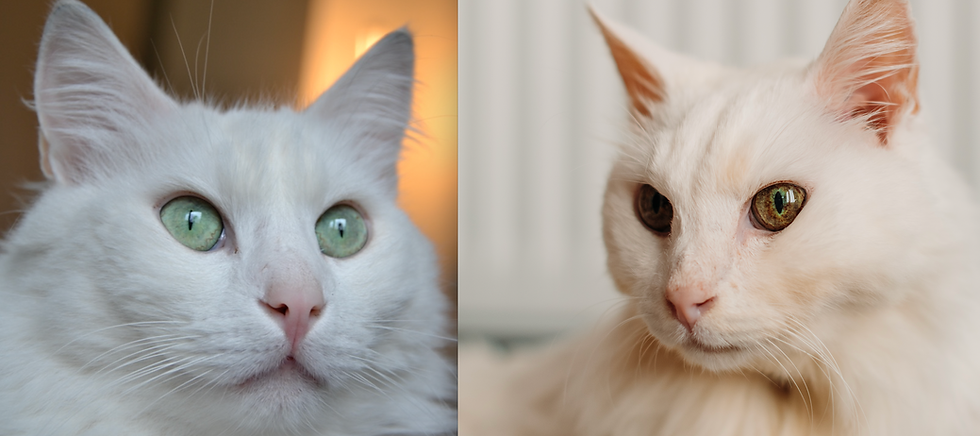
I designed a pendant of glass in the colours of his eyes as they changed over the years. The pendant will have some of his ashes in it and will be worn near my heart, next to that little Lewis-shaped hole.
I created new rituals and held on to old ones.
Incense is still lit each morning, not to mask the scent of old-cat-house, but to create a moment of mindfulness. I hold his urn with ashes next to my heart each morning and evening and speak to Lewis as if his body were still in my arms.
I occasionally open up the zip-lock bag with his collected fur, to sniff up his scent, wary not to do it too often and “finish” the smell. I now have a photo of us from when we just arrived in the UK next to my bed, hoping that if he’s the last thing I see before I fall asleep, he might come to visit my dreams that night. And Jamie and I still say: ‘Slaap lekker, Lewlew’ before the lights go out (meaning ‘sleep well, Lewlew').
Making sense of loss - seeing signs or synchronicities
As a child, I hoped my parents would get me a little dog, a best friend all for myself, who would know me inside out, and vice versa. At every wishing well I visited, I donated a coin and a (non-religious) prayer for that companion.
Different from a break-up, death feels painfully permanent. Perhaps your break-up will be forever, but you still know this person is living their life in the same world that you are. Losing someone to death feels more permanent.
I have lost pets before, and human loved ones. Yet, losing someone as close to me as Lewis has made me understand better why people hold on to religions and rituals. I now have a strong sense of 'this can’t be it'. It could be that I’m just holding on to something, the idea of his soul still being 'there', but would that be a problem? I now not only know, but understand on a deeper level how believing in something we can’t measure can help in the process of making sense of loss and life.
I would say that this loss has given me something new: Hope. That I will one day be able to hold a person with Lewis’s spark or essence - whether in this life or in whatever comes next.
After Lewis died, I started reading Philip Pullman’s His Dark Materials, as his description of Lyra’s relationship with her dæmon Pantalaimon has always felt the closest to my relationship with Lewis. That Pan’s favourite manifestation of himself was a white ermine may have spurred this connection. Reading about the dæmon-human connection helped me make sense of what we had (or have) - and why it hurts so much right now.
I never realised before that Pullman based this relationship on Plato’s daimon, a being who sits between God and men (Source). I started reading up on daimons and Plato’s writings and found out that Plato’s Symposium, in which he wrote about daimons, also includes an example of Achilles (the great warrior), who attained daimonic status because his soul was driven by a force (Eros or Love) that was greater than his mortality.
Lewis’s official pedigree name was Achilles. That little dog I hoped for as a child turned out to be a fluffy, white travelling cat who behaved like a dog and knew me inside out - and vice versa. We got to spend a blissful full cat-life together.
Who am I to say that Hoping doesn’t work?
Embracing the experience of loss and the clarity it can bring
I have always known that Lewis wasn't going to be with me forever, in the physical sense. I have been outspoken about my choice of moving from palliative to hospice care. I have been preparing for this moment for a very long time. And for years, I have been supporting others through the journey of end-of-life decision-making and afterwards, sense-making. You would think this would be easy for me. Yet, nothing could have prepared me for what I have experienced this February. And frankly, I am still currently knee-deep in the experience. Something in me has shifted fundamentally, and I can't put into words what it is. Relationships have changed. Some have cemented for life by people saying or writing exactly what I needed to hear at a certain point in this process. Grief shows you who you can rely on during the darkest hour. Unfortunately, there's also another side to that coin.
Grief also makes you see what is truly important to you. For me, this is living a life of connection with all species and being of service to the caregivers and their companion animals who are in the autumn and the winter of their lives. Right now, I am getting by, putting on my own oxygen mask first. I know that this is paramount to be able to continue helping others. I don't know how long it will take, so I'm taking it day by day.
Because I know there will be a time when I will have the strength again to help others have a love-filled journey through the autumn of their companion animals' lives. And I will continue doing the work in memory of my weak spot, my Achilles.
Sies.
About me
My name is Sieske Valk (pronounced as Sees-kuh Falk). I started my career as a veterinary nurse in the Netherlands. After a short stint working as a social science researcher, I set up an animal care company in London, called Sies Petcare. This grew into Autumn Animals, the UK’s first holistic palliative and hospice care organisation. Trained as an end-of-life doula for companion animals, I supported numerous families through the autumn of their furry friend’s life, and after. I live with my husband Jamie, in beautiful Devon and have a Lewis-shaped hole in my heart.
I now support veterinary businesses that want to improve their palliative and hospice services and support their team through challenging cases. If you’d like to have a chat about this, go to www.calendly.com/autumnanimals or visit autumnanimals.com for more information.


Thank you Sieske for your tender sharing around this universal but deeply personal journey <3 much love (I got shivers with your closing sentence, those moments of synchronicity and intuition are a gift from the universe, or somewhere...).
Beautiful and sad ❤️